Coverage where people work
Floors, stairwells, basements and back rooms that currently have weak or no signal.
Cell Signal & DAS (Distributed Antenna Systems)
Concrete, steel and low-E glass block cell signal. A distributed antenna system (DAS) brings strong coverage from the outside into offices, tenant floors, basements and parking areas, so calls, texts and data work for staff, tenants and visitors on all major carriers.
What you get
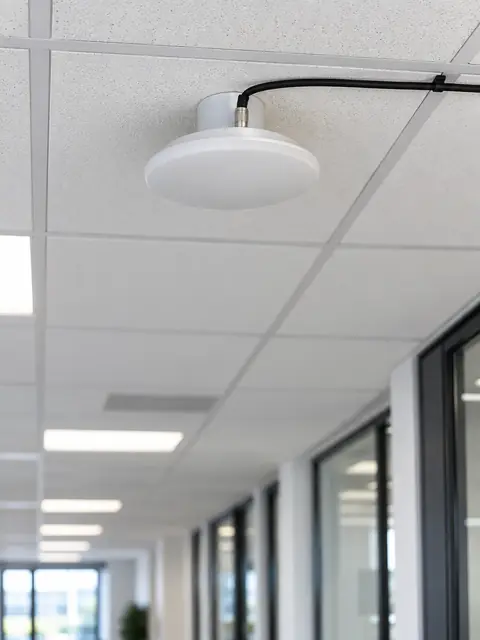
Floors, stairwells, basements and back rooms that currently have weak or no signal.
A system planned for several carriers, so tenants and visitors are covered, not just one phone plan.
Layout, materials and floor plans decide antenna count and placement. We plan around them.
Coax and fiber paths installed, labeled and documented, using the same standards as the rest of our work.
We take signal readings before and after, floor by floor, so you can see the improvement.
Tenant changes, new carriers and added floors are easier when the system is documented.
What most people don’t know
Plain answers from the install side, so you can decide with the full picture.
A signal booster is usually a single amplifier with an outside antenna and a few inside antennas. It suits a small office, a shop or a single home. A DAS is a network of many antennas spread across a larger building and fed from a central head-end, sometimes with fiber between floors. It suits large buildings, multi-floor offices, hospitals, schools, and properties with basements or garages. The right answer comes from the building size and the signal outside, not from a brand.
Reinforced concrete, steel framing and metal-coated energy-efficient windows are great for efficiency and strength, and terrible for radio waves. Newer buildings are often worse than older ones for this reason. Basements and interior rooms can lose signal entirely.
Large systems connect to the carrier networks, and carriers expect to review and approve them. The process can take time, and some carriers have their own requirements. We plan for this up front, so approval does not surprise you late in the project.
Wi-Fi calling can help staff, but it does not cover everyone: visitors, emergency calling, some apps and phones that are not set up for it still depend on the cell network. If people tell you they cannot get a signal inside, Wi-Fi calling is a workaround, and a DAS is the fix.
How it works
We look at the space, talk through how you use it and what you want to fix.
A written plan and clear price. Changes are agreed before work happens.
Neat, labeled work, with respect for your home or business.
We test everything, walk you through it and stay available after.
FAQ
For a small space, a booster may be enough. For a large building, multiple floors or a basement, a DAS is the better fit. A survey tells us which.
The system is planned for the carriers you need, and we confirm details for your location during the survey.
Carriers review larger systems. We plan for it and handle the coordination with you.
Often yes, with antennas placed where the signal is weakest. We confirm during the survey.
It depends on the size of the building and carrier review. We give a schedule in the quote.
A short description is enough. We will reply with next steps and a written quote.